



Frequently Asked Questions
Most Frequently Asked Questions FAQ
What are available payment methods?
Inside Kuwait
- KNet
- Cash On Delivery (COD)
Outside Kuwait
- Pay via Payal. You can use any credit or debit cards to pay. A Paypal account is not necessary, you can checkout directly using any Credit or Debit cards (Visa & Mastercard)
- Wire Transfer. Upon checkout, you can select bank transfer method. Please note there is a 5KD fee for bank transfers. Once payment is received, the order is immediately shipped.
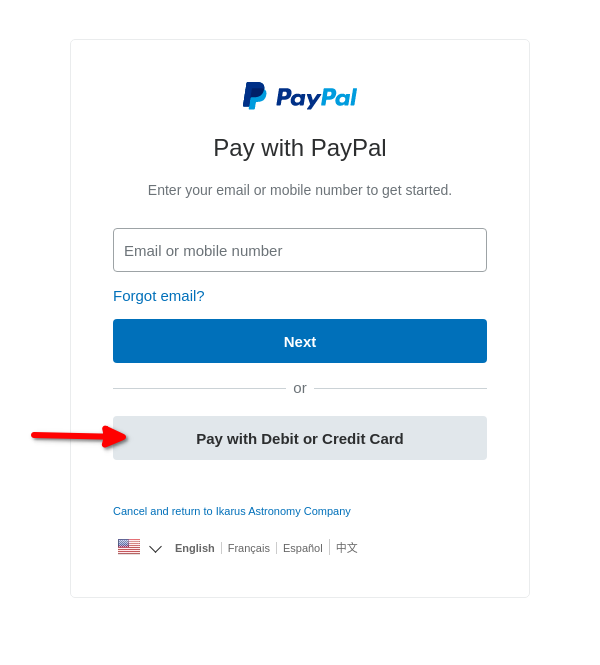
When checking out using Paypal, you can skip account sign in by click on Pay with Debit or Credit Cardas illustrated below.
What are the delivery charges inside Kuwait?
The delivery charges in Kuwait are 3.5 KD for all areas except the following areas:
- Sabah Al Ahmed - 5 KD
- Al Kheiran - 10 KD
- Al Zoor - 8 KD
- Al Wafra - 10 KD
- Kabd - 5 KD
- Al Abdaly - 12 KD
- Mutlaa - 5 KD
What are the delivery charges outside Kuwait?
Can I return a product or exchange it?
Do you ship to Arabian Gulf countries?
General FAQ
Who are we?
What are available payment methods?
Inside Kuwait
- KNet
- Cash On Delivery (COD)
Outside Kuwait
- Pay via Payal. You can use any credit or debit cards to pay. A Paypal account is not necessary, you can checkout directly using any Credit or Debit cards (Visa & Mastercard)
- Wire Transfer. Upon checkout, you can select bank transfer method. Please note there is a 5KD fee for bank transfers. Once payment is received, the order is immediately shipped.
When checking out using Paypal, you can skip account sign in by click on Pay with Debit or Credit Cardas illustrated below.
What are the delivery charges inside Kuwait?
The delivery charges in Kuwait are 3.5 KD for all areas except the following areas:
- Sabah Al Ahmed - 5 KD
- Al Kheiran - 10 KD
- Al Zoor - 8 KD
- Al Wafra - 10 KD
- Kabd - 5 KD
- Al Abdaly - 12 KD
- Mutlaa - 5 KD
What are the delivery charges outside Kuwait?
Can I return a product or exchange it?
How long does the warranty last and what does it cover?
Where is the Ikarus Tech store located? What are the working hours?
السالمية- شارع سالم المبارك- مجمع البستان (مقابل مركز سلطان و بجانب مجمع الفنار) في الدور السرداب
ساعات العمل من الساعة 12 ظهرا و حتى الساعة 9 مساء و الجمعة من 4 و نص العصر إلى 9 و نص مساء و الإثنين مغلق.
AlBustan Mall, Shop 5, Salmiya, Kuwait
Salmiya, Salem Al-Mubarak Street, AlBustan Mall (opposite Sultan Center and next to AlFanar Mall) in the Basement.
Working hours:
Week days including Saturday: 12pm to 9pm
Friday: 4:30pm to 9pm.
Monday: Closed
For the updated work hours on special occasions or holidays, click here
Do you ship to Arabian Gulf countries?
What's the difference between Express and Economy shipments?
DHL offsers two types of shipping options on checkout:
- Express: This is fast shipping service via Air. It takes 2-3 days for the package to arrive.
- Economy: This is slower shipping service using Ground. It takes anywhere from 7 to 14 days to arrive at your destination depending on how it is from Kuwait. Economy service is only available for GCC countries.
Telescopes FAQ
What is a suitable telescope for children?
We recommend the AstroMaster 60AZ for children ages 6 through 12. We recommend it because it is a small and lightweight economical telescope but it provides a great introduction to astronomy and space exploration. Let your child explore the amazing views of the moon and its craters.
We also recommend taking it with the Future Scientists Obervation Package, tailored specifically for children, as it contains what your child needs for learning and entertainment.
What are the advantages of a computerized telescope?
What are the types of telescopes and what is the difference between them?
There are 3 types of telescopes
The two main types are the refractor and the neutron reflector
Light-breaking telescopes: They are a common model of what telescopes should be (i.e. a long glossy tube with a large lens at the front and a magnifying lens at the back) and the front lens focuses light to form an image in the back. The magnifying glass is a magnifying glass through which you look at the image. Usually, astronomers who track the moon and planets demand high-quality refracting telescopes, since they appreciate the clear, high-contrast picture that can undergo high magnification. Indeed, when a refracting telescope is well crafted, it can provide the best images that can be obtained using any aperture.
Also, the length of the tube may be impractical in common shapes for refracting telescopes, as a refracting telescope with aperture of 4 inches can reach four feet or more. Since the lens is located at the bottom of the tube, a holder is expected to be able to observe objects high in the sky. Such tripods must be durable in order to prevent oscillations at high levels, so they may be heavy or impractical, not to mention that they are expensive.
Reflecting telescopes: These are those that use a mirror to collect and focus light. Perhaps the most popular type is the Newtonian Reflector Telescope (invented by Isaac Newton), with a basic, curved, concave (plate-shaped) mirror at the bottom of the telescope. Near the top is a small secondary diagonal mirror that directs light from the primary mirror to the side of the tube, where it is matched by an appropriately placed lens.
And if you want the best aperture for your money, then a reflecting telescope is for you. A well-designed reflector telescope can produce clear, high-contrast images of all celestial bodies for only a fraction of the cost of a telescope with an equivalent aperture.
When you combine this feature with the low center of gravity of the Newtonian telescope under the lens, you will get a tool that is placed on a stable stand, which will make the lens at a suitable height to point it anywhere in the sky. A reflecting telescope has another benefit, as it is the only type of telescope that shows a correct image instead of a mirror image. This is very important if you are trying to compare what you see in the lens with the star map.
Cassegrain Telescopes (Schmidt-Cassegrain): It is a hybrid telescope; It merges the telescope design pioneered by the German lens manufacturer (Schmidt) with that of the French optometrist (Cassegrain). This telescope combines several lenses and mirrors that work together as a monolithic optical system.
The light rays fall into a Schmidt-Cassegrain telescope tube from a spherical mirror, the primary mirror, and collect on another, smaller spherical mirror called the secondary mirror. Unlike the formation of the Newtonian telescope, the light reflected from the secondary mirror is not directed towards the side exit of the tube, but rather is directed to the center of the main mirror. There is an opening in the center of the main mirror, thus the light beam can exit and be directed to the vision lens system. The secondary mirror is located in the middle of a slice of glass (Schmidt plate) and is attached by means of thin carriers. The function of this panel is to correct the spherical dysfunctions resulting from the main spherical mirror and to reduce this dire disorder in the system to the lowest possible degree.
What is the difference between the Alt-Azimuth, Equatorial and Dobsonian Mounts?
The Alt-Azimuth Mount (AZ) is the simplest of the rules, there are two axes of movement: the first is the altitude (up and down) and the second is the azimuth, which causes the telescope to move from side to side. This elevation is a circle representing 360 degrees around the horizon, with the original northern point being 0 degrees and the south at 180 degrees. Then, the azimuth axis simply allows the rotation to move in a circle parallel to the Earth.
The Equatorial Mount (EQ) is the most common, designed to move with Earth's motion, and this design enables one of the two axes to be polar aligned. And looks more like a letter T, the upper part of the letter is the polar axis, which tilts until it is parallel to the earth's axis. This means that only the telescope, which is at one end of the T-arm, is tracked around the polar axis, to follow the path of the stars as they rise from the east and sunset from the west. It is ideal for tracking a specific astronomical object in the sky.
The Dobsonian Mount, invented by the astronomer John Dobson, is another form of the Alt-Azimuth Mount. Its primary purpose is to provide a cheap and stable platform for large-size telescopes, and is characterized by very smooth movement in both axes. This is achieved by using frictionless Teflon mounts, so that the user can direct the telescope without losing the observed object from the field of view. This is a very popular mount because it is inexpensive.
How powerful is the telescope magnification?
The magnification power depends on two main factors:
The focal length of the telescope
The focal length of the eyepiece lens
To calculate the magnification power, divide the focal length of the telescope by the focal length of the eyepiece lens. For example, if the focal length of the telescope is 1000 millimeters (mm) and the focal length of the eyepiece lens is 10 mm, then the magnification force is
1000/10 = 100x
Whereas if you use a 20mm lens with the same telescope, the magnification power will be:
1000/20 = 50x
That is, the zoom strength increases as the focal length of the eyepiece decreases.
But this does not mean that the higher the magnification force, the greater the clarity becomes. There is a higher level of clarity depending on the size of the telescope as well as the weather factors. In every telescope you will find the feature of the strongest useful magnification, which is the upper limit of useful magnification.
Which telescope is suitable for me as a beginner?
There are several options and all of them are great. Just bear in mind that the more the diameter of the telescope, the more things can be seen and the greater the price. If it is a manual or computerized telescope, if it is computerized it will increase its cost as well.
So if you are looking for an inexpensive telescope and you can see the moon and planets, we recommend:
AstroMaster 114EQ
AstroMaster 90EQ
And if you want a light, easy-to-navigate telescope to see the Moon, we recommend the Travel Scope 70mm.
And if you want it computerized:
NexStar 90SLT
NexStar 127SLT
NexStar 4SE
There are excellent telescopes as a start, but they are expensive since they are large in size and more sophisticated:
NexStar Evolution 5
NexStar Evolution 6
NexStar Evolution 8
And of course there are large and inexpensive telescopes! They are the Dobsonian telescopes:
SkyLine 8 ”
SkyLine 10 ''
I want to learn astrophotography, how do I start?
You can photograph the moon, so you need a narrow-range ZWO camera, a telescope of any kind, and you can also use a DSLR camera.
As for photographing deep nebulae, the most important thing is to use the equatorial tracker and for it to be computerized.